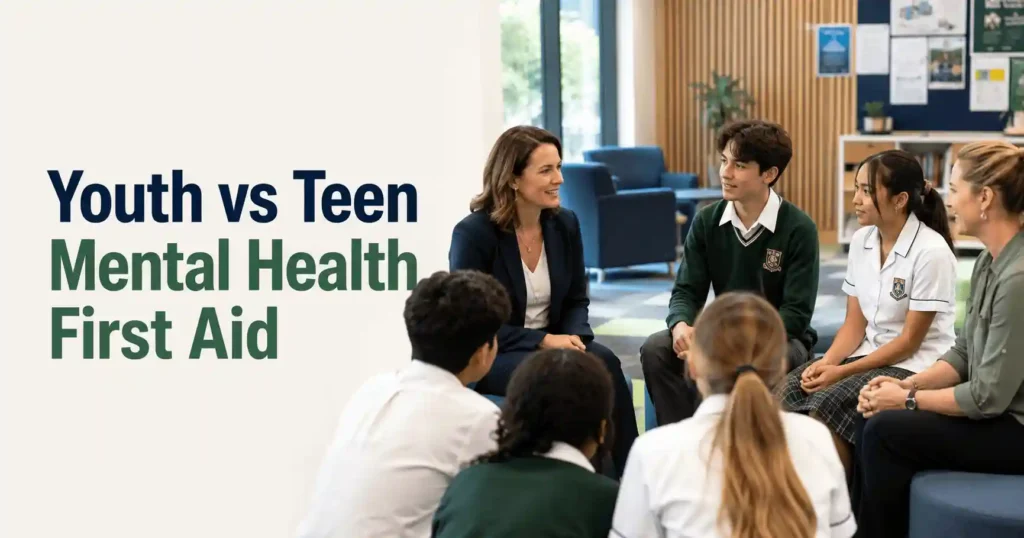
Youth vs Teen Mental Health First Aid: Which Training Is Right for Your School?
Schools are often among the first places where changes in a young person’s wellbeing become visible.
A student who was once engaged may begin withdrawing from friends. Another may struggle to concentrate, become unusually irritable, miss classes, or stop participating in activities they previously enjoyed. Teachers and classmates may notice these changes before the young person speaks to a parent, counsellor, or health professional.
Recognising that something has changed is important. Knowing how to respond is equally important.
This is where mental health first aid training can strengthen a school’s existing wellbeing framework. It gives people practical skills to recognise potential mental health concerns, begin a supportive conversation, and connect someone with appropriate help.
However, schools exploring mental health first aid often encounter two options that sound similar: Youth Mental Health First Aid and Teen Mental Health First Aid.
Despite their names, these courses are designed for different participants and serve different purposes. Youth Mental Health First Aid prepares adults to support young people, while Teen Mental Health First Aid teaches secondary school students how to respond when they are concerned about a peer.
Understanding this distinction can help schools select the right starting point and develop a more coordinated approach to student wellbeing.
What Is Youth Mental Health First Aid?
Youth Mental Health First Aid is designed for adults who teach, care for, work with, or support young people.
Participants may include:
- teachers and education support staff
- school leaders
- wellbeing coordinators
- sports coaches
- youth workers
- parents and carers
- community volunteers
- staff working in extracurricular programs
The training focuses on how an adult can provide initial support to a young person who may be developing a mental health problem, experiencing a worsening condition, or facing a mental health crisis.
Mental Health First Aid Australia identifies the relevant age group as young people between 12 and 18 years old. Participants learn to recognise possible signs of mental health problems, start an appropriate conversation, provide initial support, and encourage the young person to access professional or other suitable help.
The course also helps adults distinguish between changes that can be expected during adolescence and signs that may indicate a more serious concern.
This distinction matters because adolescence is a period of significant emotional, social, physical, and developmental change. Mood changes, growing independence, shifts in friendships, and occasional conflict can be part of normal development. At the same time, persistent or significant changes in behaviour, functioning, mood, or relationships may require closer attention.
Adults need enough knowledge to respond thoughtfully without making assumptions or trying to diagnose the young person.
A structured youth mental health first aid training course can help teachers, parents, youth workers, and other supporting adults build this confidence. The objective is not to turn participants into therapists. It is to prepare them to offer appropriate initial support until professional help is available or the immediate situation is resolved.
What Is Teen Mental Health First Aid?
Teen Mental Health First Aid is designed for secondary school students.
Rather than training adults to support young people, it teaches teenagers how to recognise and respond when a friend or classmate may be experiencing a mental health problem or crisis.
Students learn how to notice concerning changes, approach a peer supportively, encourage help-seeking, and involve a trusted adult when needed. The course is tailored for students in Years 7 to 9 and Years 10 to 12 so that the content can be delivered in an age-appropriate way.
This peer-focused approach reflects an important reality of adolescent life. Young people often talk to friends before they speak with a parent, teacher, counsellor, or health professional.
A teenager may tell a friend that they feel overwhelmed, unsafe, hopeless, or unable to cope. The friend receiving that information may care deeply but have no idea what to say or do.
Without guidance, the student may try to manage the situation alone, promise to keep dangerous information secret, dismiss the concern, or take on responsibility that should belong to an adult.
A well-designed teen mental health first aid program teaches students that supporting a friend does not mean becoming their counsellor. It means noticing when something may be wrong, responding with care, and helping the person connect with a trusted and responsible adult.
The Main Difference Is Who Receives the Training
The simplest way to understand the two courses is to look at the participant.
Youth Mental Health First Aid is for adults who support young people.
Teen Mental Health First Aid is for students who may need to support a friend or classmate.
This difference shapes everything else, including the language, scenarios, responsibilities, learning outcomes, and delivery format.
Adults are likely to have greater responsibility for safeguarding, referral, communication with families, workplace policies, and access to professional services. Their training needs to reflect these responsibilities.
Students have a different role. They may be the first person to hear that a friend is struggling, but they should not be expected to assess, treat, or independently manage a serious mental health concern.
Teen training therefore places strong emphasis on recognising warning signs, offering appropriate peer support, and seeking help from a trusted adult.
Youth MHFA Builds Adult Capability
Teachers and school staff regularly interact with students across classrooms, playgrounds, extracurricular activities, camps, and informal conversations.
This gives them many opportunities to notice changes. It can also place them in situations where a young person shares sensitive or confronting information.
An adult may need to respond when a student:
- appears persistently distressed or withdrawn
- describes intense anxiety or panic
- shows signs of an eating disorder
- discusses self-injury
- expresses suicidal thoughts
- appears affected by alcohol or other drugs
- experiences a sudden decline in daily functioning
These situations require more than general awareness.
The adult needs to remain calm, listen without judgement, understand the limits of confidentiality, follow safeguarding procedures, and know when further assistance is required.
Youth MHFA helps participants develop a practical framework for these conversations. The official Australian course covers common mental health problems affecting adolescents, along with crisis situations that can require immediate or additional support.
The course can be particularly valuable for staff members who have regular contact with students but do not have specialist mental health qualifications.
A classroom teacher, office employee, sports coach, librarian, or support worker may not be part of the formal wellbeing team. Even so, they may be the adult a student trusts enough to approach.
Training creates a wider network of adults who can respond consistently and connect students with the school’s established support pathways.
Teen MHFA Builds Peer Support Skills
Young people are already supporting one another, whether schools formally recognise it or not.
They notice changes in group chats, friendship circles, sports teams, classrooms, and social activities. They may see posts that concern them or receive private messages late at night from a friend who is struggling.
The aim of Teen MHFA is not to make students responsible for each other’s mental health.
Instead, it gives them safer and more realistic ways to respond.
Students learn that they can listen, express concern, and encourage help-seeking. They also learn that some situations should be shared with a trusted adult, even when a friend asks them to keep the matter secret.
This can reduce the pressure placed on the student providing support.
A teenager should not have to decide alone whether a friend is in danger. They need clear guidance about when and how to involve a responsible adult.
Teen MHFA also gives schools an opportunity to challenge common misconceptions about mental health. Students can develop a more accurate understanding of mental health problems, recognise the importance of early support, and become more confident discussing concerns without using stigmatising language.
Mental Health First Aid Australia describes the program as peer-to-peer support that continues until a trusted adult can provide assistance. It is designed to improve recognition, supportive responses, help-seeking, and knowledge of available support pathways.
Teen Training Does Not Replace Adult Training
One of the most important implementation principles is that student training should not operate without trained adult support.
Teaching students to identify concerns may lead to more disclosures and requests for help. Schools must be prepared to respond appropriately when this happens.
Mental Health First Aid Australia requires a minimum proportion of supporting adults to have completed Youth MHFA before Teen MHFA is delivered. Its current guidance states that at least 10 percent of supporting adults, such as school staff or volunteers, must have completed Youth MHFA training.
This requirement reflects the relationship between the two programs.
Students are taught to approach trusted adults. Those adults therefore need the confidence, knowledge, and systems to respond effectively.
Without that foundation, a student might follow the training correctly, raise a concern, and encounter an adult who minimises the situation, panics, or does not know what to do next.
That experience could discourage future help-seeking.
For this reason, schools should see Youth and Teen MHFA as connected parts of a wider support structure rather than competing course options.
Which Course Should a School Choose First?
For most schools, Youth MHFA is the logical starting point.
Training adults first helps establish the support capacity that students will rely on. It also gives the school an opportunity to review its policies, referral pathways, escalation procedures, and communication practices before introducing peer-focused training.
A school may begin by training a cross-section of adults, including:
- senior leaders
- teachers from different year levels
- wellbeing and pastoral care staff
- education support employees
- sports or activity coordinators
- administrative staff with regular student contact
The school can then consider Teen MHFA once enough adults have been trained and the appropriate support systems are in place.
Teen training may be particularly suitable when the school wants to improve mental health literacy across an entire year level or student cohort. The official program is designed to be delivered to a whole cohort rather than only selecting students who are already viewed as leaders or peer supporters.
A whole-cohort approach can help prevent students from being labelled as the school’s unofficial counsellors. It reinforces the message that mental health literacy and help-seeking are relevant to everyone.
Questions to Ask Before Selecting a Program
Choosing a course should be part of a broader planning process.
Before booking training, school leaders should consider several practical questions.
Are Enough Adults Prepared to Respond?
The school should assess how many staff members already have relevant training and whether trained adults are available across different year levels, locations, activities, and school hours.
A small wellbeing team cannot be everywhere at once.
Are Referral Pathways Clear?
Staff and students should know who to contact when a concern is raised.
This may include a school counsellor, wellbeing coordinator, psychologist, safeguarding lead, parent or carer, general practitioner, community mental health service, or emergency support.
The pathway may differ depending on the urgency and nature of the concern.
Do Staff Understand Confidentiality?
Students need honest information about privacy.
Adults should not promise to keep information confidential when a young person may be at risk of harm. Staff need to know what must be reported, who should receive the information, and how to explain this process respectfully.
Is the School Ready for More Conversations?
Effective training can increase people’s ability to recognise concerns and ask for help.
That is a positive outcome, but it may also increase demand on wellbeing services. Schools should consider whether they have sufficient capacity to respond to additional disclosures or referrals.
How Will Families Be Involved?
Parents and carers should understand the purpose and boundaries of the training.
Clear communication can prevent the mistaken belief that students are being trained to diagnose or treat their friends. Families should know that the program focuses on early recognition, safe peer support, trusted adults, and professional help.
Training Must Be Supported by School Systems
Mental health first aid can improve knowledge and confidence, but training alone cannot carry an entire wellbeing strategy.
Schools still need clear safeguarding policies, accessible professional support, effective communication, and a culture in which students feel safe asking for help.
They should also consider the everyday factors influencing student wellbeing.
Academic pressure, bullying, social exclusion, discrimination, family difficulties, online behaviour, identity concerns, and uncertainty about the future can all affect how a young person feels and functions.
Schools cannot remove every challenge from adolescence, but they can create environments where concerns are noticed and taken seriously.
Training is most effective when supported by:
- clearly identified trusted adults
- visible and accessible support pathways
- regular staff development
- appropriate family communication
- anti-bullying and inclusion policies
- strong links with external health services
- follow-up after concerns are raised
The objective is not simply to complete a course. It is to create a reliable network around students.
A Combined Approach Creates Stronger Support
Youth MHFA and Teen MHFA address different parts of the same challenge.
Young people often notice when their peers are struggling. Adults have greater responsibility and capacity to organise further support.
When both groups understand their roles, the pathway to help becomes clearer.
A student can recognise a concerning change, approach their friend, and involve a trusted adult. The adult can respond appropriately, follow school procedures, engage family or professional support where necessary, and continue checking on the young person’s wellbeing.
This creates a shared support model without placing clinical responsibility on teachers or emotional responsibility on students.
For schools deciding where to begin, the answer is usually to build adult capability first. Youth Mental Health First Aid creates the foundation required for safe and effective student participation.
Teen Mental Health First Aid can then extend that foundation by giving students age-appropriate peer support and help-seeking skills.
The strongest school mental health strategies do not force a choice between adults and students. They prepare both groups for the different roles they play, while making sure that professional support remains central.
When adults are ready to listen and students know where to turn, concerns are more likely to be recognised early and handled with care.