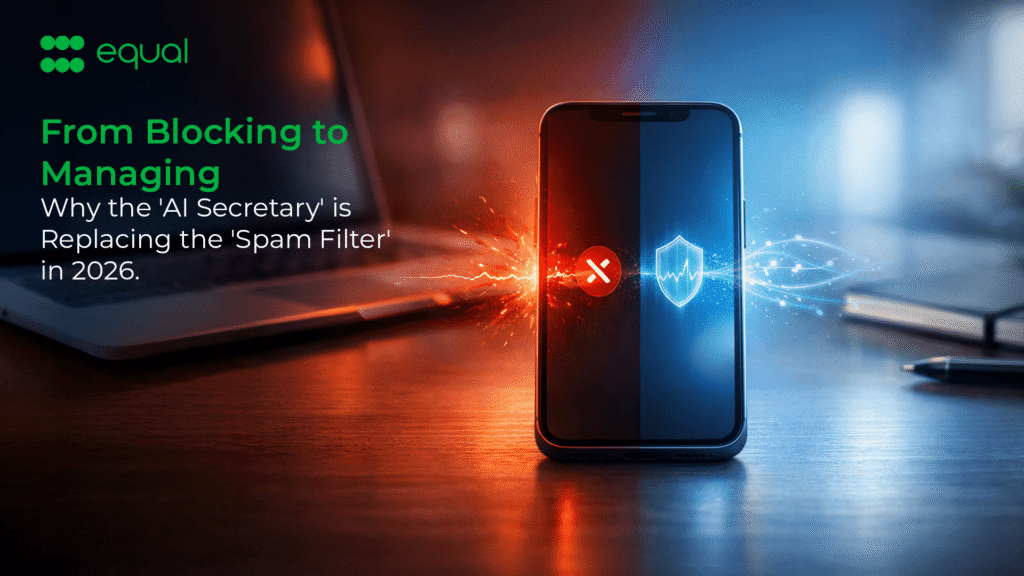
The entire design philosophy of most call management tools has followed a single idea: stop things from reaching you by blocking the number. And for a while, that felt like progress, because being interrupted less felt like winning.
But here’s what it actually does: it makes you passive. And in the process, you’re just as likely to miss something important as you block something irrelevant. 2026 is the year that changes. Not because spam got better, but because our tools finally did. That began with the introduction of the AI phone secretary called Equal AI.
The Problem With “Block” Strategy
Blocking is outdated. What it essentially functions is based on a single idea: this number has caused a problem before, therefore it should never get through again. There are several reasons why this logic becomes problematic in the real world.
- Numbers rotate constantly: telemarketers, scammers, and spam operations cycle through new numbers faster than any database can track them
- Legitimate numbers get misused: a real company’s number can be spoofed or flagged incorrectly, meaning important calls never arrive
- Context is completely absent: a blocked number from a financial institution could be a fraud alert or a loan offer; blocking treats both identically
- Silence creates its own anxiety: not knowing what you missed is a different kind of stress, not the absence of it
- New numbers aren’t in any database: first-time scammers and new telemarketing campaigns are invisible to systems that only recognise what they’ve seen before
The Secretary Model: A Completely Different Philosophy
Think about what a good human secretary actually does when an unknown caller reaches the front desk.
They don’t hang up. They engage professionally on your behalf. They ask who’s calling, what it’s regarding, and whether it’s urgent. They take notes. And then they bring you only what needs your attention, in a form you can act on immediately. That is the model that the AI call manager, like Equal AI app, is built around.
Instead of asking “should this reach the user?”, the secretary model asks:
- Who is this, and what do they want?
- Is this urgent, routine, or promotional?
- What information does the user need from this interaction?
- Can this be handled without the user’s direct involvement?
How Equal AI Puts This Into Practice
Equal AI is designed entirely around the secretary model. Every feature in the app exists to answer one question: how do we give the user control over their communication without needing them to be present for every interaction?
Here’s how the experience actually unfolds:
- Unknown number calls → Equal AI picks up automatically, presenting a natural, conversational voice to the caller — not a robotic gatekeeper
- The AI engages the caller → asking questions, gathering context, and managing the interaction in real time
- A live transcript streams to your screen → you read the conversation as it happens, with full context, without saying a word
- You choose your level of involvement → step in immediately, send a message for the AI to relay, or let it conclude the call entirely on your behalf
- A clean summary is delivered post-call → who called, what they wanted, what was said, and whether any action is needed from you
This is not a call screener in the traditional sense. It’s an active participant in your communication that handles the full interaction so you can engage with the outcome directly.
The “Opt-In” Shift: You Decide When to Engage
The most important shift in the secretary model is this: It’s your choice whether you want in or out of a conversation. Under the old model, every call needed your immediate attention until proven otherwise. Under the secretary model, the dynamic reverses entirely:
- Your default state is undisturbed: calls are handled without requiring your presence
- Conversations come to you as information: a transcript and summary, ready when you are
- You engage only when it’s worth your time: stepping in live when something genuinely requires your voice
- Timing belongs to you: review summaries between meetings, during a commute, or at the end of the day
Built Around Privacy, Not Just Performance
A secretary you can’t trust with your information isn’t much of a secretary. Equal AI is built with data protection as a foundational principle:
- No phonebook uploads: your contacts are never shared or stored externally
- No data shared with third parties: confirmed in the app’s own data safety declaration
- All data encrypted in transit: every interaction is protected end-to-end
- Deletable on request: users retain full control over their data at all times
The Bottom Line
Spam filters were built for a simpler time, and they did their job well. But in 2026, communication is far more complex, and important to be handled by more than just blocking calls. An AI phone assistant goes a step further. It doesn’t just protect you from bad calls; it manages all your calls. It can handle routine ones, flag urgent ones, summarise useful information, and make sure you only deal with what truly matters.
Think of it this way: your phone shouldn’t feel like a locked door that shuts everything out. It should work like a well-run front desk that is organised, efficient, and always in your control.